Ask Your AI Assistant About a Stock You Own: Get Facts, Not Memory
You own a stock. It dropped 20% this month, or it reports earnings on Tuesday, or you read a headline and wonder if the story changed. So you ask an AI assistant. A plain chatbot answers from its training data, which can be months old: it doesn't know today's price, it hasn't seen last week's news, and it can't tell you who at the company sold shares in August. It will still answer, and it will sound confident.
With Stocklake connected, your AI agent (Claude, ChatGPT or another) looks things up before it answers. It pulls the current price and trend, recent news, the insider transaction rows, an AI summary, and scores computed from the company's own filed statements. Below are three real conversations I ran on the weekend of September 27, on stocks a lot of people hold. For each one: what I typed, what came back, and what a good answer should cover. Prices are the Friday, September 25 close.
1. Axon dropped hard. What happened?
The most common question: a stock you hold is falling and you want to know why, and whether anything underneath it is actually broken.
What came back (as of Sept 25)
- Price and trend: $430.11, about 44% below the 52-week high of $764.02 and roughly 30% down over the month. It sits below both its 50-day average ($538.52) and its 200-day average ($500.47). RSI is 34.7. Analysts still rate it “buy”: 19 analysts, mean target $704.
- The catalyst, from the news: on Sept 18 Axon sold $1.15B of 0% convertible notes due 2031, which raised dilution and liquidity worries. By Sept 22 headlines noted the stock had fallen 22% in a month, and a Seeking Alpha piece the same day argued it was expensive at about 290x trailing free cash flow. On Sept 23 Axon declined a Senate hearing invitation, and the LAPD approved a license-plate-reader pilot with the company.
- AI summary: negative verdict, ai_score 52. Negative near term, neutral long term, falling alongside a weak Industrials sector.
- Insiders (follow-up): no buys and seven sales between June 29 and Sept 11, about $38.2M in total. The CEO sells 10,000 shares a month (for example on Sept 8 at $509); the President sold $9.6M on Aug 31 and the CTO $6.0M on Aug 21. Institutions went the other way: 696 added shares versus 463 that cut, with about 91% institutional ownership.
- Extra context: Williams %R at −93 (oversold on that measure), a “laggard” relative-strength read (−38.7% over 12 months, about 56 points behind the S&P 500), and an Altman Z-Score of 8.81, in the safe zone.
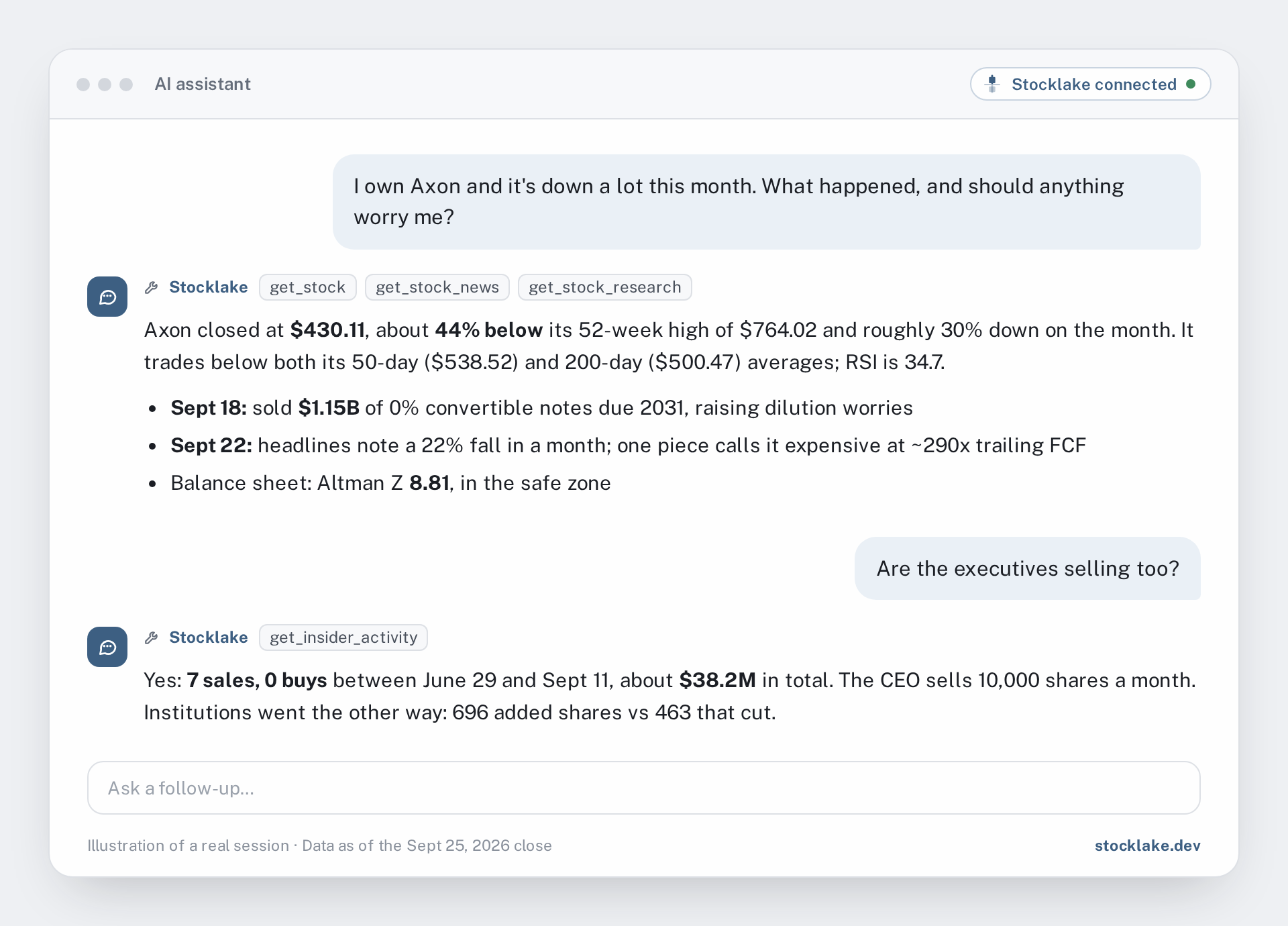
- It names the catalyst: dilution worries from the convertible offering, which came about a month after a solid Q2 report and a guidance raise on Aug 14.
- It separates trend from short-term state: the trend is broken, but the stock is oversold in the short run.
- It reports insiders and institutions separately: steady executive selling with no buys, while funds on balance were adding.
- It checks the balance sheet: bankruptcy-style risk looks low on the Altman score.
2. Micron reports this week. What should I watch?
Before an earnings report you want the bar the company has to clear and a sense of how much good news the price already reflects. I asked this before Micron's September 30 report; the numbers below were pulled on Sept 27.
What came back (as of Sept 25, pulled Sept 27)
- The date: Micron reports Sept 30 after the close (confirmed).
- The bar: consensus, per a Sept 22 news item, is EPS of about $31.30 on revenue of about $50.6B. For comparison, the prior quarter (ended May 31) brought revenue of $41.46B versus $9.30B a year earlier, and diluted EPS of $24.67.
- Price and run-up (follow-up): $1,082.28, against a 52-week range of $159.97 to $1,255, up about 591% over 12 months and far above its 200-day average ($661). RSI 63; Williams %R at −12.7, in overbought territory. Analysts rate it “strong buy”: 46 analysts, mean target $1,516. Forward P/E is 6.8.
- AI earnings view: ai_score 62, neutral near term and positive long term. The risks it flagged: estimates have been raised, which lifts the bar; the stock is near its upper Bollinger band after a very steep run; and insider selling has been heavy.
- Insiders: the CEO sold 40,000 shares on each of June 26, July 24 and Aug 21, roughly $38-46M each time. No buys.
- Side note: on Sept 24 the US International Trade Commission opened an investigation following a complaint from Netlist.
- Balance sheet: Altman Z of 24 (safe) and a Piotroski F-Score of 7.
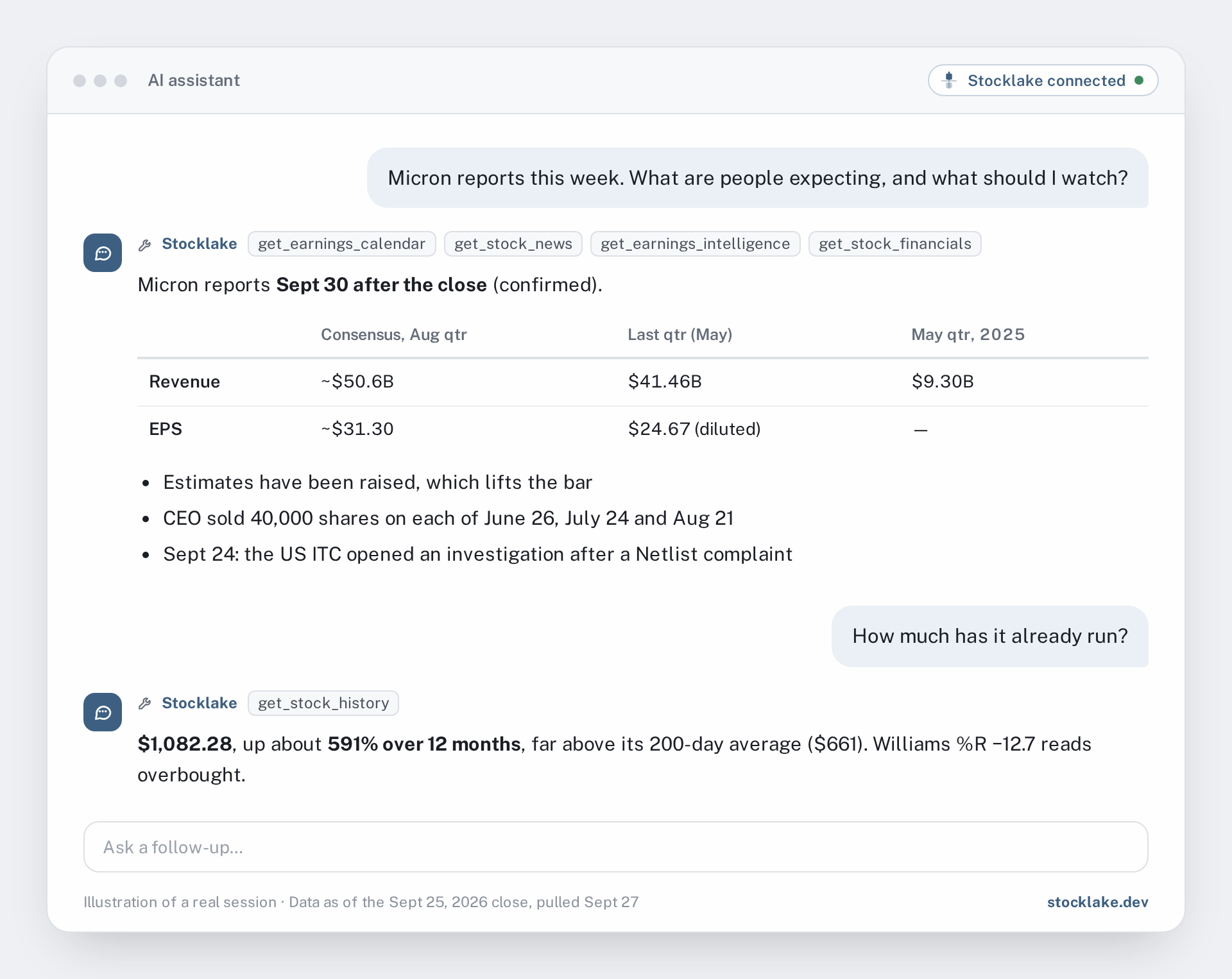
- It gives the date and the time of day, and the consensus numbers the report will be measured against.
- It shows the prior quarter's real reported figures, so you can see how big the jump is that the consensus expects.
- It says how far the stock has already moved, using the price history rather than a vague “it's had a big run.”
- It lists concrete risks with dates (the insider sales, the ITC investigation) instead of generic ones.
3. Intel has tripled. What's the case for and against?
When a stock has run a long way, it helps to see both sides laid out with dates and sources. I asked for both, then asked who on the inside was buying.
What came back (as of Sept 25)
- Price: $123.00, against a 52-week range of $32.89 to $142.35. RSI 68.7, above its 200-day average ($79). Analysts rate it “buy”: 43 analysts, but the mean target of $116.37 sits below the current price.
- The case for: talks with SK Hynix about making memory in the US (Reuters, Sept 16); a $23B raise for AI capacity (Aug 26); and institutions net added about 96M shares over the past 90 days.
- The case against: a $15B stock sale on Aug 10 (dilution); RealSense sold to Cognex for $600M (Sept 22); Bay Area layoffs (Sept 23); a trailing net margin of −19.8%; a forward P/E of 59.6; and Williams %R and the Ultimate Oscillator both in overbought territory.
- Insiders (follow-up): CEO Lip-Bu Tan bought 105,263 shares at $95 on Aug 11, about $10M. The only sale was by the foundry chief, $2.5M on May 29. Nvidia (4.26%) and SoftBank (1.72%) are among the top holders.
- AI summary and scores: neutral verdict, ai_score 58. Altman Z 4.13 (safe), Piotroski F-Score 6.
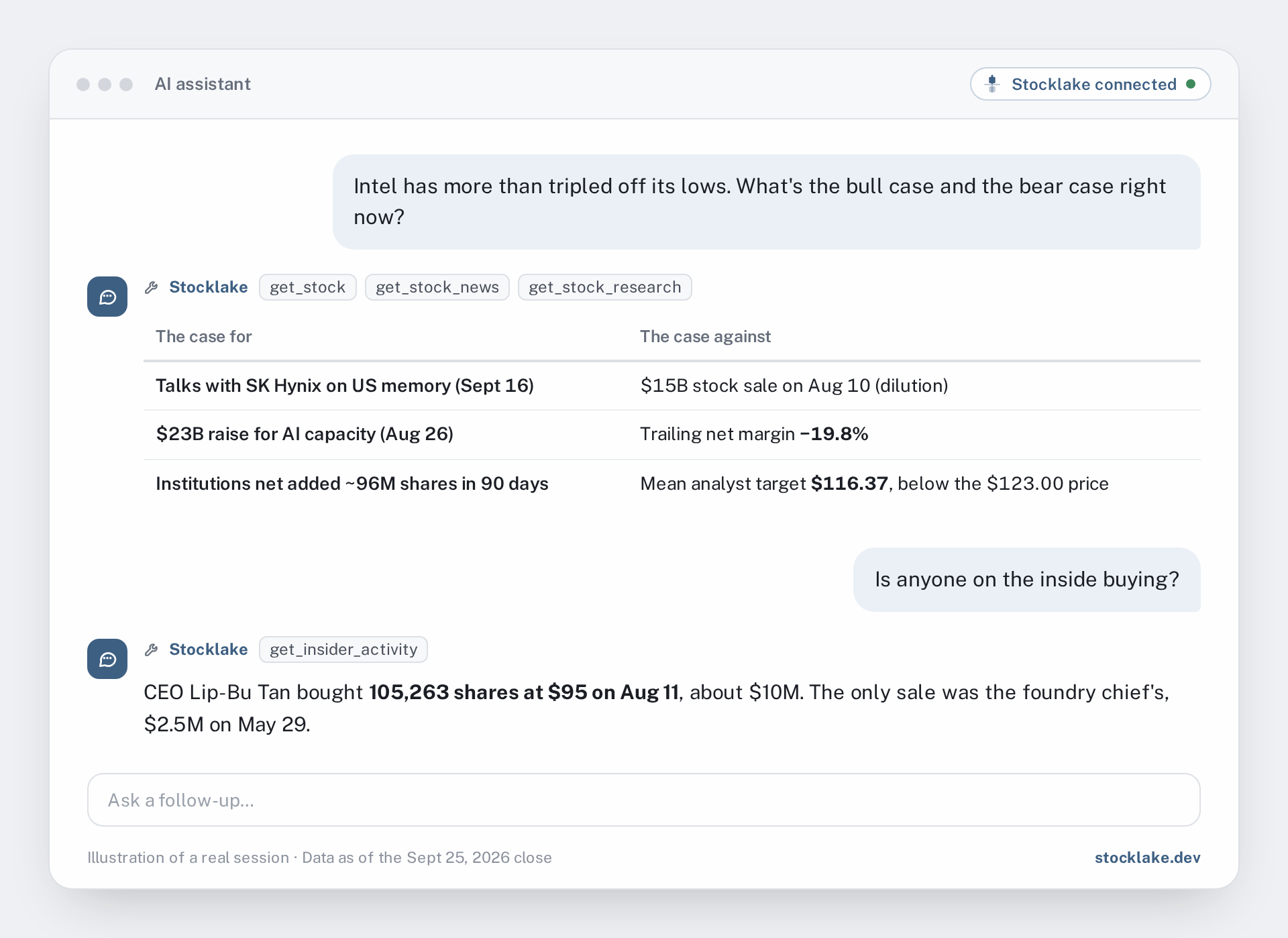
- Both sides get dated, sourced points, not adjectives.
- It notes where the numbers disagree with the story: the analyst mean target is below the price, and the trailing margin is negative.
- On insiders, it gives the actual row (who, how many shares, what price, which date), not just “insiders are buying.”
Free vs Pro for this question
You can ask all three questions on the free tier and get a useful first answer. What changes with Pro is how much of the “why” the assistant can see.
- Current price and 52-week range
- RSI and moving averages
- Analyst consensus and mean target
- Next earnings date
- Recent plain headlines
- AI summary and news sentiment
- The full insider transaction list
- Five years of statements plus quarterlies
- Forensic scores (Altman Z, Piotroski F, Beneish M)
- Technical rating and the full indicator breakdown
Tips for better answers
- Ask your agent to cite the insider transaction rows. The one-line summary of insider activity can lag the individual filings. Asking for the rows (name, date, shares, price) gets you the actual record.
- Ask for dates on news. “Put the date next to each news item” is enough. It shows you which story came first, and whether the move is about last week or last quarter.
- Keep follow-ups in one chat. The follow-ups above (“are the executives selling too?”) work because the agent still has the first answer in context. Starting a new chat for each question throws that away.
Setting it up
Stocklake works in Claude, ChatGPT and other MCP clients. You add it once as a connector (the connector URL is https://api.stocklake.dev/mcp), and it's then available in every chat, including on the web, on desktop and in mobile apps that support connectors. You can start on the free tier without a card, and add a Pro key later if you want the insider list, the full financials and the AI summaries. The step-by-step setup for each client is in the docs.
Frequently asked questions
Yes, if your assistant's mobile app supports MCP connectors. Once Stocklake is added as a connector to your account, it's available wherever you use that assistant: on the web, on desktop and in the mobile app. The conversations in this post work the same way on a phone.
Stocklake is an MCP server, so it works with Claude, ChatGPT and other assistants and agent tools that support MCP connectors. The setup steps for each client are in the docs.
No. Stocklake provides market data and research context: prices, technicals, news, insider filings, financial statements and scores computed from them. It doesn't generate trade calls, and nothing in this post is a recommendation to buy, sell or short any security.
The free tier already answers the basics: price, 52-week range, RSI, moving averages, analyst consensus, the next earnings date and recent headlines. Pro adds the parts that explain the move: the AI summary and news sentiment, the full insider transaction list, five years of statements plus quarterlies, forensic scores and the technical rating.