Follow the Insiders: Ask Your AI Assistant Who Is Buying and Selling
“Insiders are selling” is one of the most repeated lines in market news, and one of the least useful on its own. Executives sell for all kinds of reasons: taxes on vested stock, a house, diversification, or a trading plan they set up months ago. Buying is different. There is basically one reason an executive spends their own money on their own company's shares in the open market.
The problem is that the useful detail lives in the individual filings, and a plain chatbot doesn't have them. It can't tell you who at a company bought shares in August, at what price, or whether a sale fits a pattern. With Stocklake connected, your AI agent (Claude, ChatGPT or another) can pull the insider transaction rows (name, role, date, shares, price, value) and reason about them. Below are three questions I asked on September 27, with what came back. Prices are the Friday, September 25 close.
Three things worth knowing first
- Open-market purchases tell you more than sales. A purchase is a choice to add risk. A sale can be about anything.
- Many sales are scheduled. US insiders often sell under a Rule 10b5-1 plan, set up in advance so the trades happen on fixed dates or triggers. Others sell to cover taxes on vesting stock, or simply to diversify.
- Several insiders buying tends to matter more than one. A cluster, where a few people buy in the same window, is harder to explain away than a single trade.
1. Is anyone at Intel buying their own stock?
Intel has been one of the big moves of the year. The natural question is whether the people running it have put their own money in.
What came back (as of Sept 25)
- The purchase: CEO Lip-Bu Tan bought 105,263 shares at $95.00 on Aug 11. The row's value is $9,999,985, so about $10M.
- The only other row: a sale of 21,024 shares at $118.28 on May 29 by Chandrasekaran Nagasubramaniyan, listed as EVP and head of foundry, worth about $2.5M.
- Where the price is now: Intel closed at $123.00 on Sept 25, which is $28 above the CEO's purchase price, or about 29.5% ($28 ÷ $95). The 52-week range is $32.89 to $142.35.
- Institutions, for context: about 62.5% institutional ownership across 3,778 holders. Nvidia (4.26%) and SoftBank (1.72%) are both among the top holders.
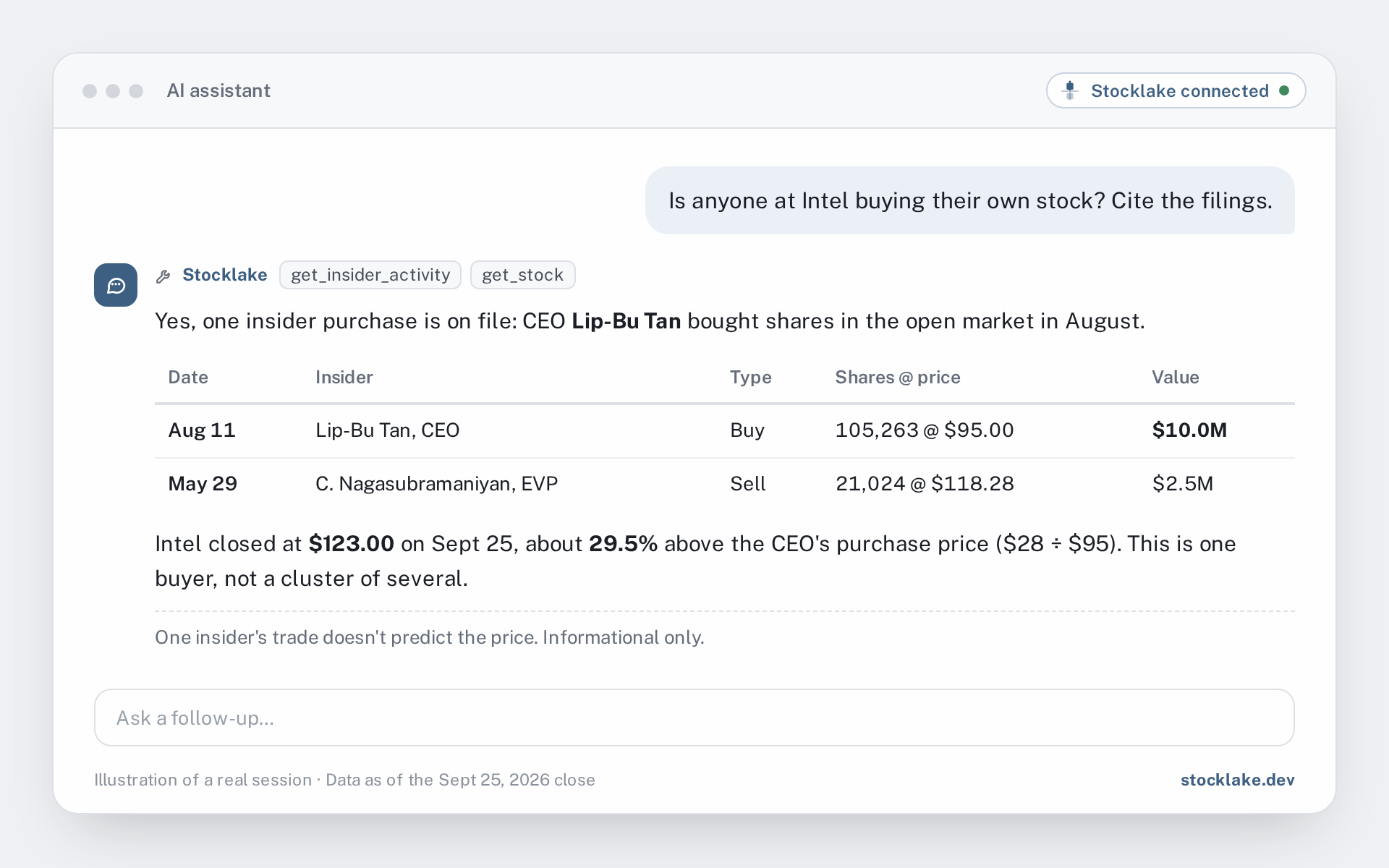
- It quotes the row itself: name, role, date, share count, price. Not “insiders have been buying.”
- It says how many buyers there were. Here it is one person, not a cluster, and one purchase is worth less weight than several.
- It puts the trade next to the current price, and doesn't turn that gap into a prediction.
2. Which of my holdings had insider buying lately?
Checking one stock is easy. The more useful question is across everything you own. I gave the assistant a list of six common holdings. If you've starred stocks on your Stocklake dashboard, you can say “my watchlist” instead and it will read the list itself.
What came back (as of Sept 25; 90 days = June 28 to Sept 25)
| Holding | Buys | Sales | What the rows show |
|---|---|---|---|
| PFE | 3 · $2.96M | 1 · $83K | CEO Albert Bourla 38,000 sh @ $26.34 (Aug 12); directors Ronald Blaylock 39,231 sh @ $25.46 and Mortimer Buckley 37,632 sh @ $25.52 (both Aug 5). About $1M each. |
| INTC | 1 · $10.0M | 0 | CEO, 105,263 sh @ $95 (Aug 11). The one sale on file (May 29) is outside the window. |
| AAPL | 0 | 6 · $2.72M | All six by the general counsel, about 1,439 shares every seven days from Aug 11 to Sept 15. |
| MSFT | 0 | 4 · $71.4M | CEO Satya Nadella 86,525 sh @ $501.46 (Sept 1, $43.4M); CFO Amy Hood $20.8M (Sept 14); two smaller executive sales in early August. |
| NVDA | 0 | 7 · $660.7M | Director Mark Stevens sold 2,870,740 shares over five days (Aug 31 to Sept 4), about $646.5M; the CFO and general counsel sold smaller amounts. |
| KO | 0 | 8 · $87.9M | Six different people selling between July 28 and Aug 20, the largest the chairman at $47.5M over two days. |
The two buys stand out against the rest: Pfizer has three insiders buying within a week, and Intel has one large purchase. Everything else is sales. That is normal for large companies, and the size alone isn't a signal: the Nvidia director's $646.5M is about 0.01% of Nvidia's $5.4T market value.
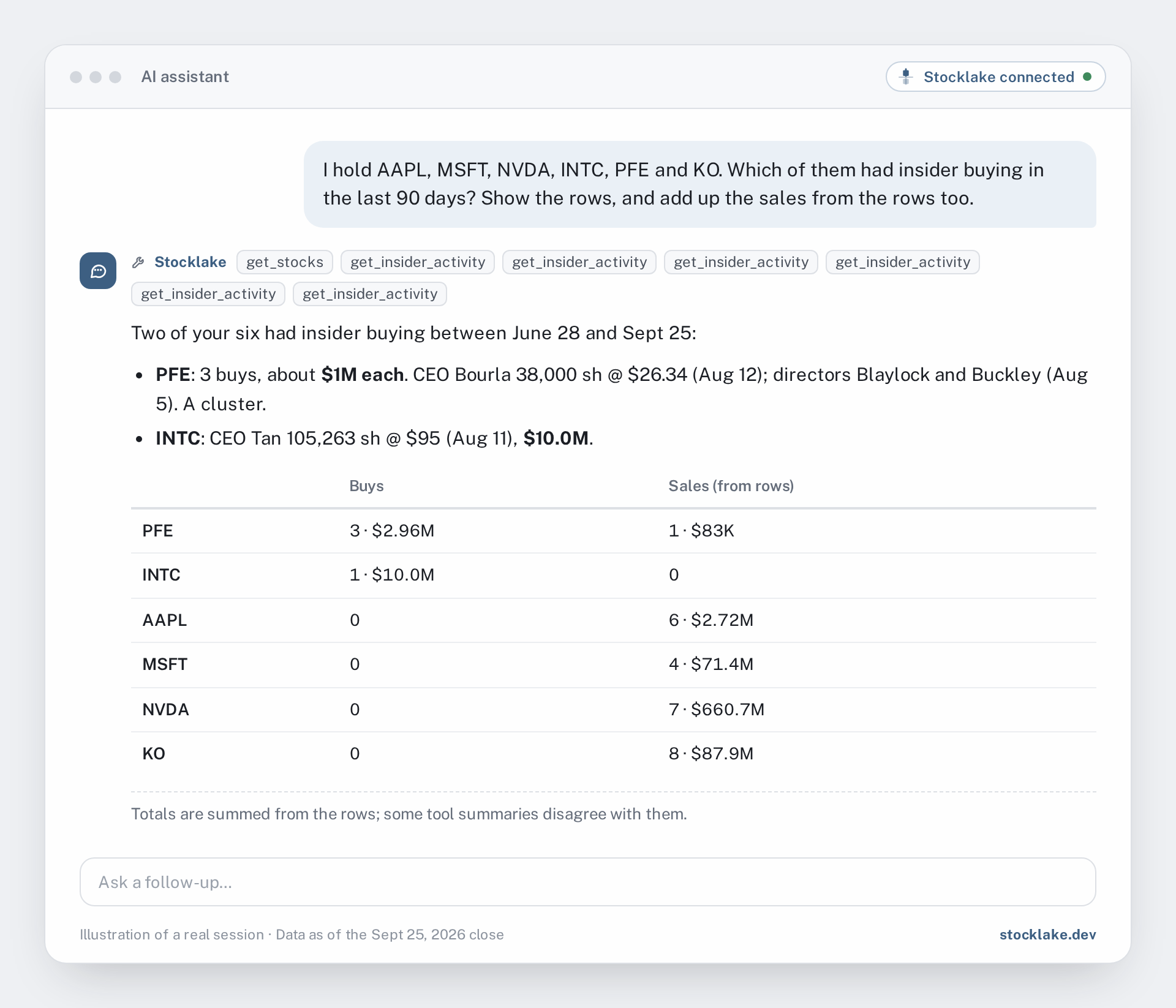
- It applies the date window you asked for, and says when a row falls outside it (Intel's May sale, Pfizer's June sale).
- It separates a cluster (Pfizer: three people, one week) from a single trade (Intel).
- It computes the totals from the rows. The tool also returns a one-paragraph summary per stock, and for several of these six it didn't match the rows (more on that below).
3. Is Micron's CEO selling on a schedule, or is this unusual?
Micron is up about 591% over the past 12 months, and its CEO has been selling. That sounds alarming until you look at when and how much.
What came back (as of Sept 25)
- The CEO's rows: Sanjay Mehrotra sold exactly 40,000 shares on June 26 (at $1,158.38, $46.3M), July 24 (at $932.25, $37.3M) and Aug 21 (at $968.90, $38.8M). Same share count each time, 28 days apart. Together, $122.4M.
- What that looks like: a fixed number of shares on a fixed interval, whatever the price did in between (it fell about 20% from the June sale to the July one, and the size didn't change). That is the pattern of a pre-set plan. The rows themselves don't carry a 10b5-1 flag, so the assistant said it couldn't confirm the plan from this data; the Form 4 footnote is where that would be stated.
- Everyone else: five other people sold between June 26 and Aug 18, including the chief people officer (40,000 shares, $43.4M, July 1) and the chief business officer (15,000 shares, $14.0M, Aug 18). No buys.
- Adding it up: eight sales in the rows, about $182.2M in total. Micron closed at $1,082.28 on Sept 25, against a 52-week range of $159.97 to $1,255.
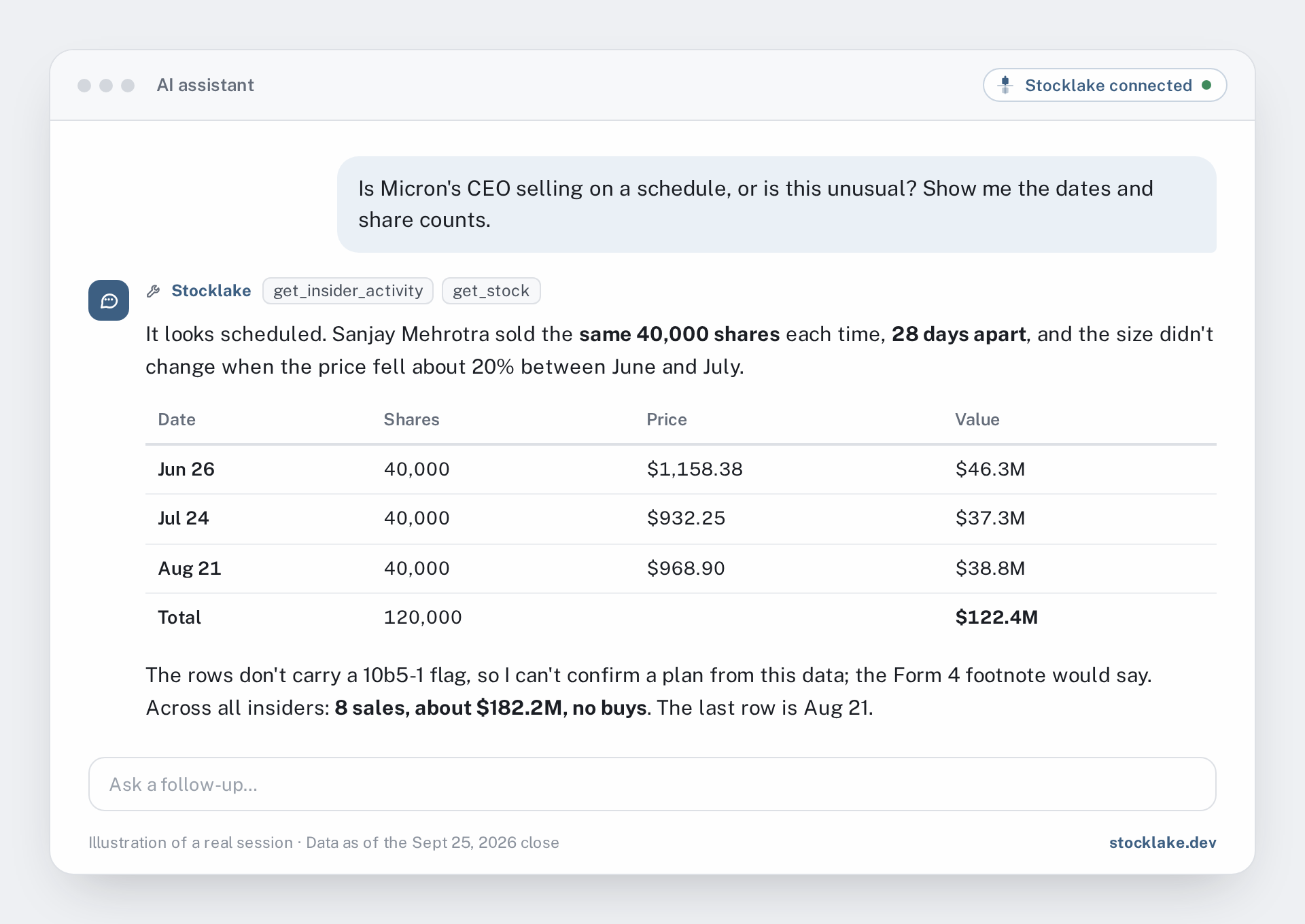
- It lists the dates and share counts and points out the pattern: same size, regular spacing, no reaction to price.
- It says what it can't tell from the data (whether a 10b5-1 plan is in place) instead of guessing.
- It shows when the rows end. The last Micron row is Aug 21; if a sale happened after that, it isn't in this list yet.
Always ask for the rows
The insider tool returns two things: the individual transaction rows, and a short written summary. The summary is generated on its own schedule, and it can lag or contradict the rows. For Micron, the summary read “58 sells/$83.0M” and put the CEO at about $6.6M on July 24. The rows show eight sales totaling about $182.2M, and the CEO's July 24 sale alone is $37.3M. Nvidia's summary said no insider transactions were detected, next to seven sales in the window. Coca-Cola's summary said $77.8M; the rows add up to $87.9M.
So the habit that matters most: ask your agent to cite the rows (name, role, date, shares, price) and to do the arithmetic from them. If the assistant ever quotes a total without the rows behind it, ask where it came from.
Free vs Pro for this question
On the free tier your assistant can still tell you where a stock trades, how it has moved and what analysts think, which is the context around any insider trade. The rows themselves come with Pro.
- Price, 52-week range and daily change
- RSI and moving averages
- Analyst consensus and mean target
- Next earnings date
- Recent plain headlines
- The full insider transaction list, every row
- Top institutional holders and ownership
- Your dashboard watchlist, readable by the assistant
- AI summary and news sentiment
- Five years of statements plus quarterlies
Setting it up
Stocklake works in Claude, ChatGPT and other MCP clients. Add it as a connector with the URL https://api.stocklake.dev/mcp. You add it once, and it's available in every chat. You can start on the free tier without a card. The step-by-step setup for each client is in the docs, and there's more on the data itself in our post on insider data for AI agents.
Frequently asked questions
From regulatory insider filings: SEC Form 4 for US companies, and the national regulators BaFin (Germany), AFM (Netherlands) and CNMV (Spain) for European ones. Each row carries the insider's name, role, date, share count, price and value.
No. An insider purchase is one piece of information about what one person did with their own money on one date. It says nothing certain about the future price. This post is informational only, not investment advice, and not a recommendation to buy or sell any security.
The insider tool returns both a one-paragraph summary and the individual transaction rows. The summary is written on its own schedule and can lag or disagree with the rows. The rows are the record: who, what role, which date, how many shares, at what price.
The free tier gives your assistant prices, 52-week ranges, technicals, analyst consensus, earnings dates and recent headlines for any stock. The full insider transaction list, with every row and the institutional holders, is Pro: $20/month, free for 7 days, cancel anytime.